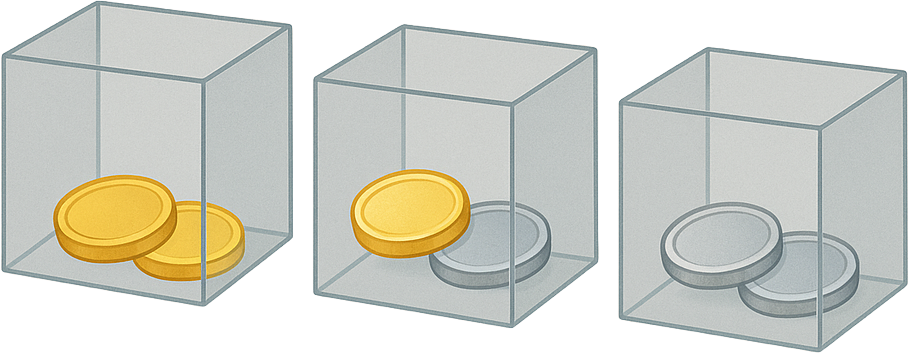
You have three boxes. One box contains two gold coins (GG), one contains two silver coins (SS), and the third contains one gold and one silver coin (GS). You pick a box uniformly at random and draw a random coin from it; the coin you drew is gold. What is the probability that the other coin in the same box is gold?
What is the probability of selecting the mixed box (GS) and then drawing a gold coin from it?
Solution
Since we already drew a gold coin, the SS box could not have been selected (probability 0). If a silver coin had been drawn that would imply we selected the GS box, which initially has chance $\tfrac{1}{3}$. Because the observed draw is gold, the remaining possibilities are the GG box and the GS box; their conditional probabilities (proportional to 1 and $\tfrac{1}{2}$ respectively) give final weights $\tfrac{2}{3}$ for GG and $\tfrac{1}{3}$ for GS. Thus the other coin is gold with probability $\tfrac{2}{3}$.
Variant: Monty Hall
Statement
There are three doors. Behind two of them is a goat, behind one is a new car. If you find the car, you can keep it. You select a door, the organizer then opens a door you did not choose which has a goat behind it, and gives you a choice to stick with your answer or change it. What should you do?
What is the probability that your initial choice was correct?
Solution (quick)
Your first pick is correct with probability 1/3. That means the remaining unopened door (after the host opens a goat door) has probability 2/3 of hiding the car. Therefore you should change your answer.